mMyCareClub
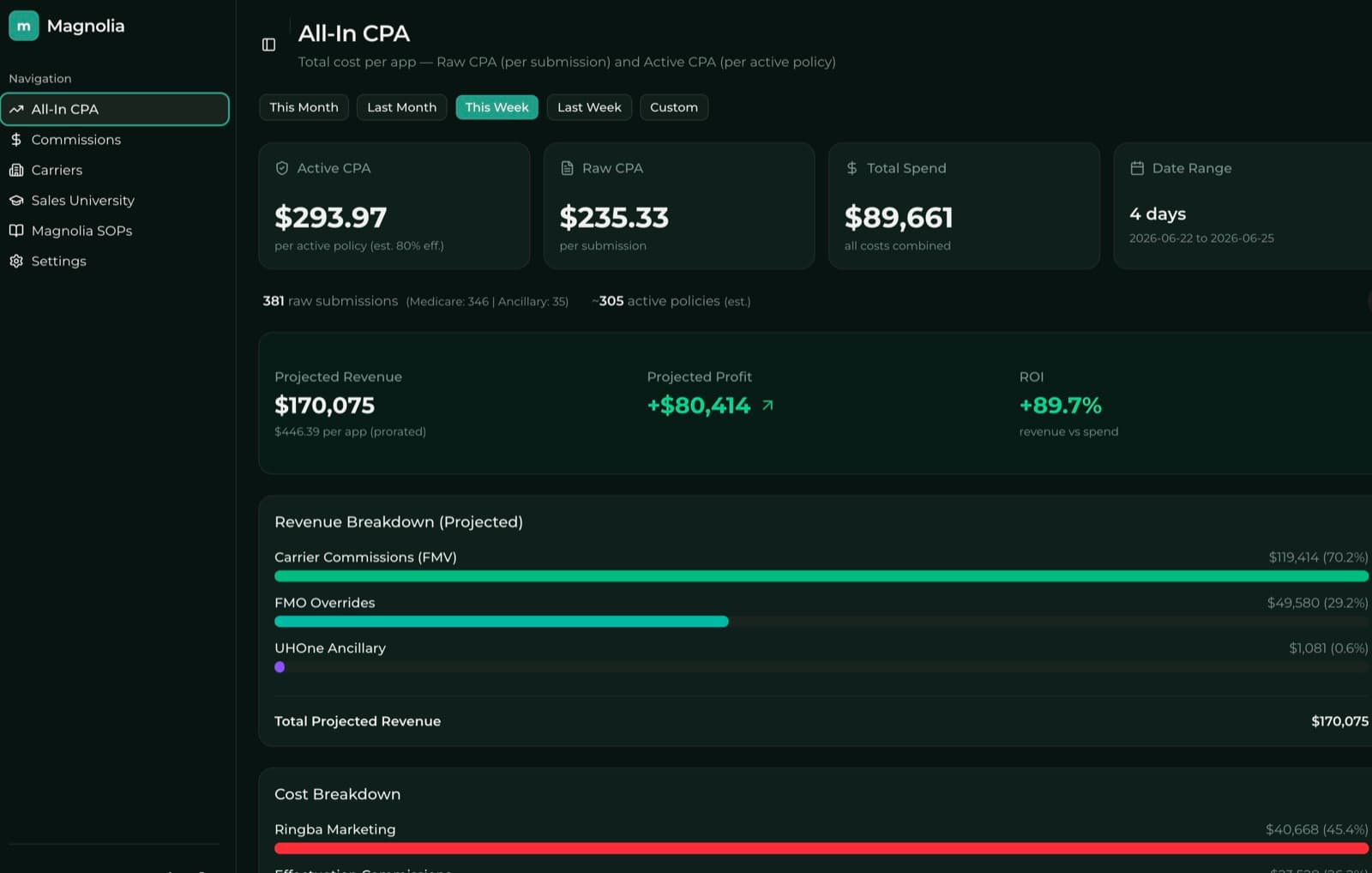
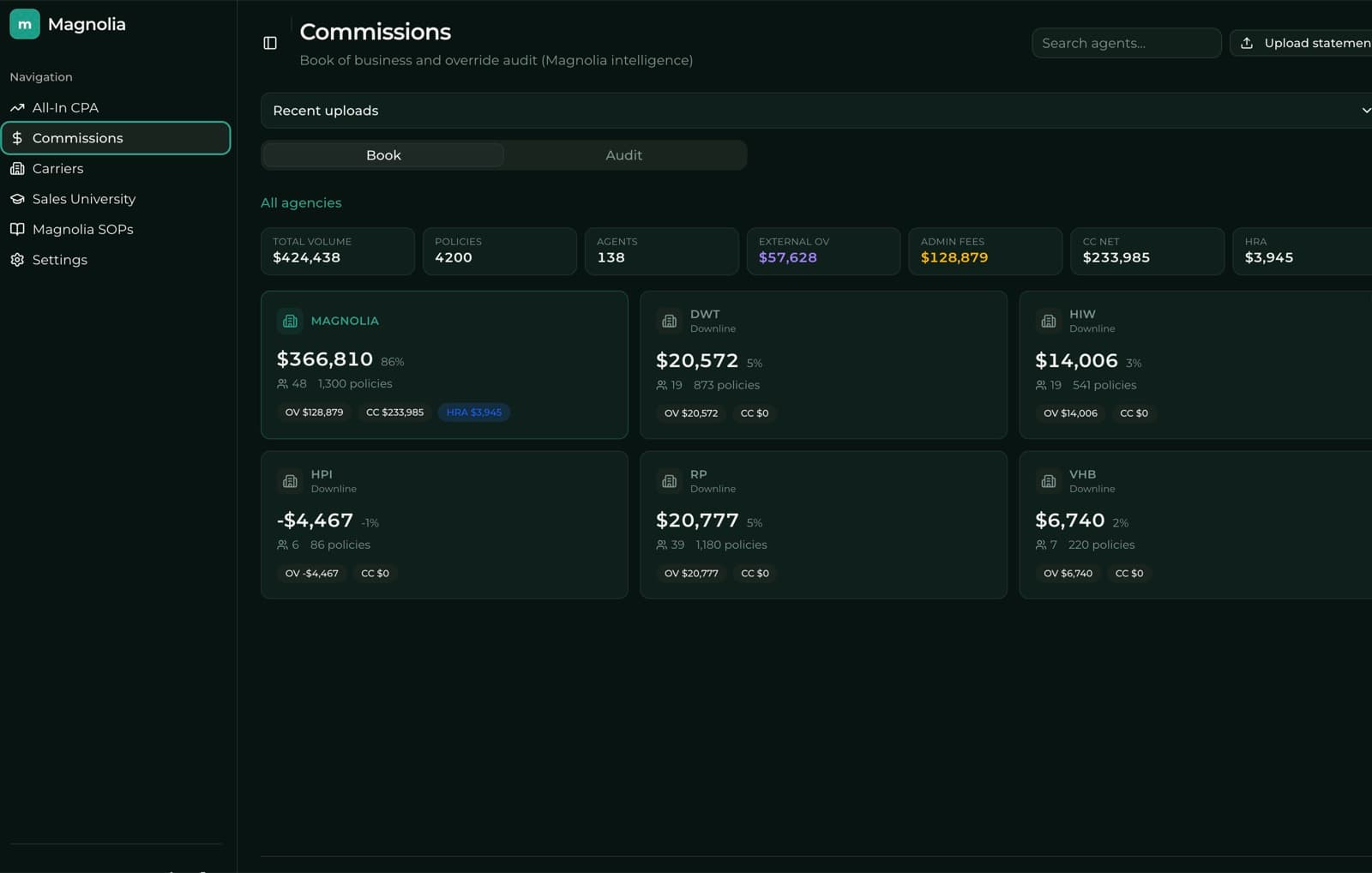
An internal AI operations console for a Medicare agency — call analytics, an AI assistant, code agents and automated reporting in one place, and underneath it a reconciliation engine that reads every carrier statement and works out what the agency was actually paid.
Across 29 carrier statements and 6,933 rows — every line matched, graded, and tied back to the carrier's own totals.
Across 128 policies a carrier clawed back commission against payments it had never actually made. Confirmed against the raw statements rather than our copy of them — every file for the period is loaded and ties to the carrier's own totals, so a missing statement can't explain it.
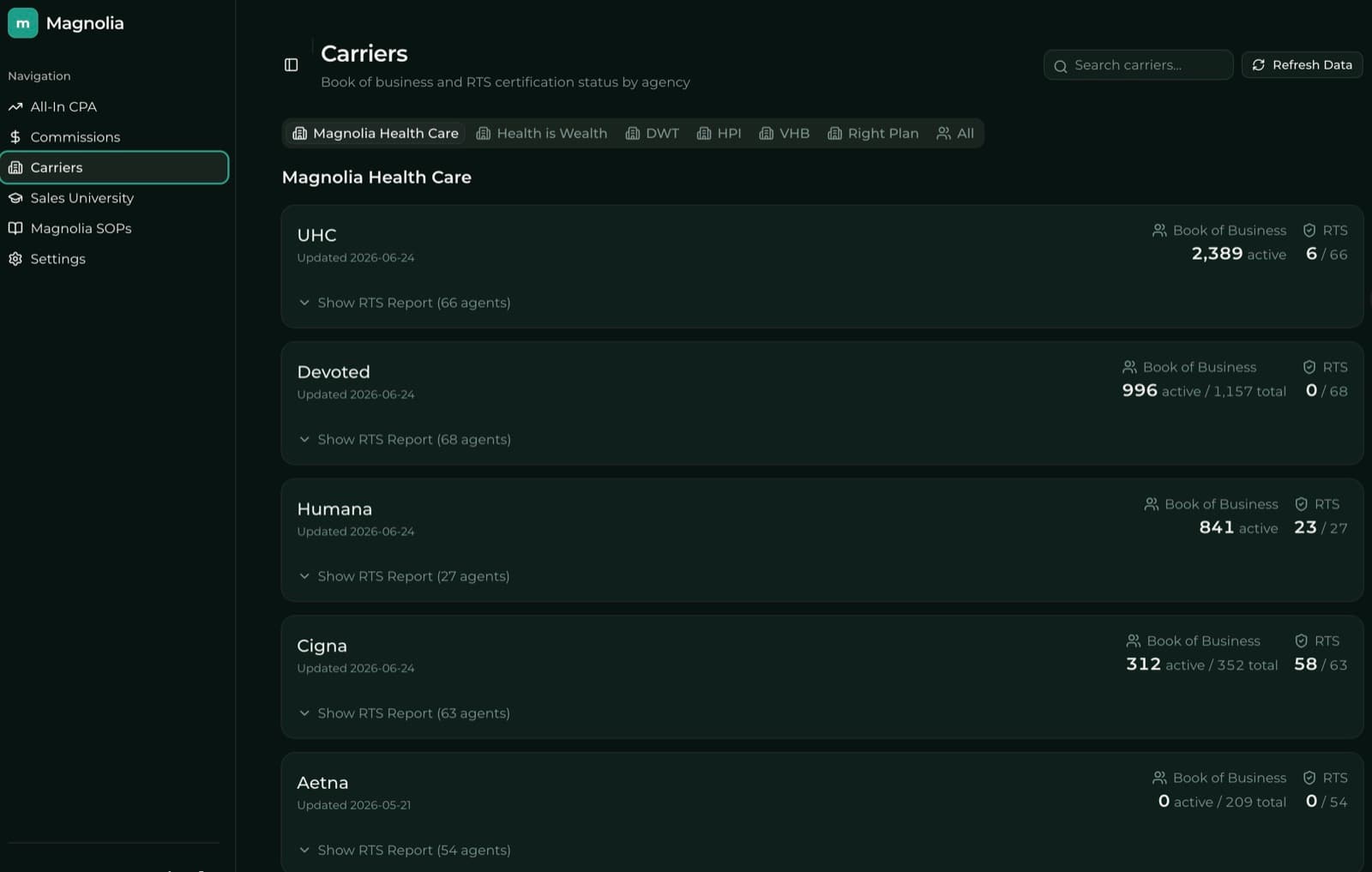
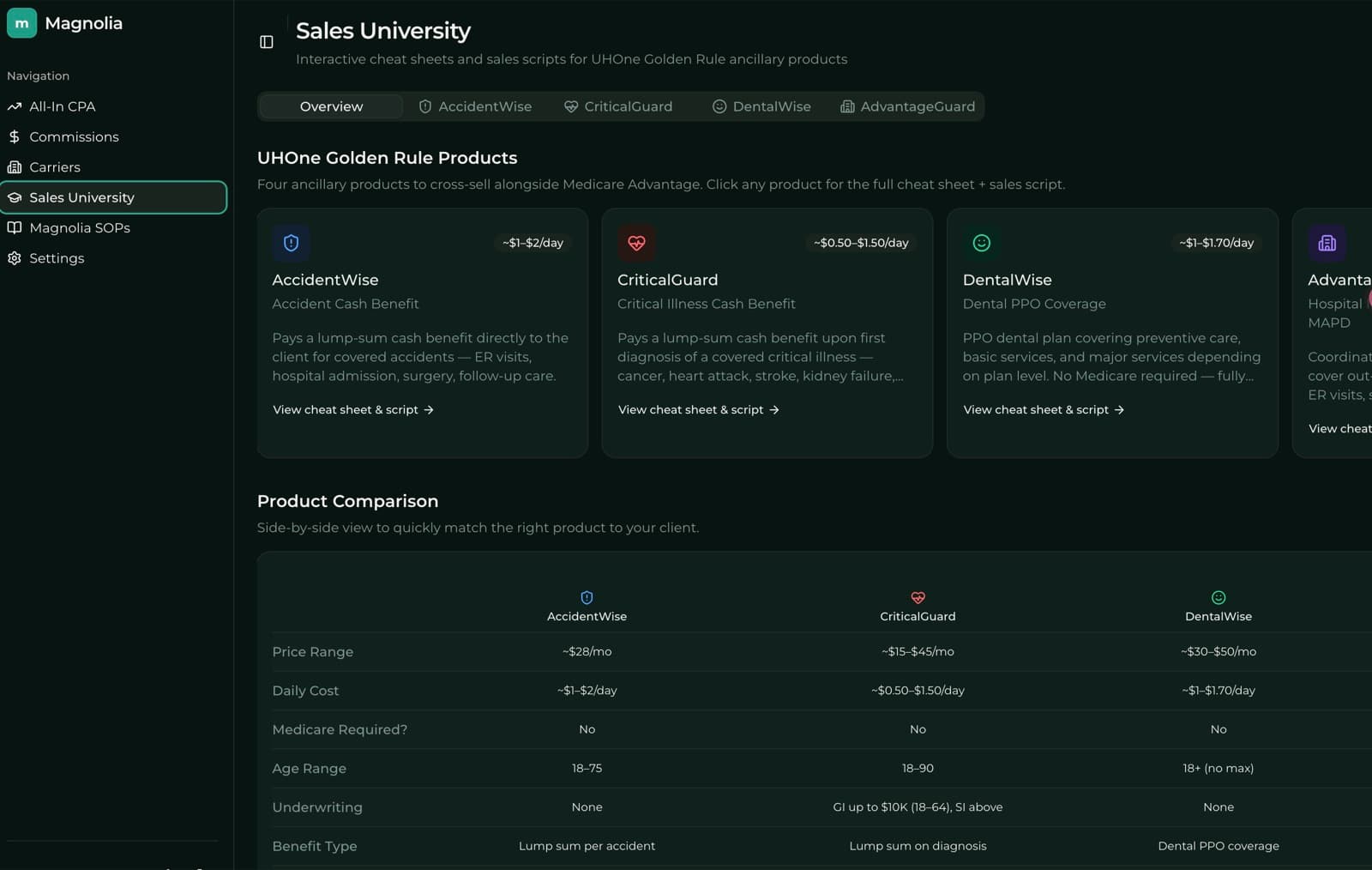
Running a Medicare agency means living across a dozen tools — a call-center platform, a CRM, spreadsheets, Slack, commissions. MyCareClub Ops pulls all of it behind a single login and turns it into dashboards, an AI assistant, and reports that generate themselves.
It's built as an integration hub: everything the operations team touches in a day, unified into one console — and increasingly, automated by AI.
Carriers pay an agency by spreadsheet, and none of them agree with the CRM — one carrier's policy numbers are nine digits where the CRM's are six, so not one of 1,369 ever matched. The engine matches on what is actually there, grades what was paid against what was owed, and checks its own arithmetic against the totals each carrier publishes on its own summary tab.
The part that makes it trustworthy is provenance: the original workbook is kept, so every figure on screen can be traced to the sheet, row and column it came from.
Renewal FMV prorated over seven months, plus a flat $150 admin fee. Matches the comp grid — paid correctly.
Real-time KPI dashboard
Live agency KPIs and charts — today, this week, this month — pulled together from the call center and CRM into one operations view.
Call-center analytics
Convoso call data turned into agent-success and daily performance reports, with campaign-level breakdowns the team actually uses.
AI business assistant
A Claude-powered chat that answers questions over the agency's data, streaming token-by-token with saved, resumable sessions.
Concurrent code agents
Launch and monitor Cursor cloud coding agents right from the console — up to four stream live at once, with pinning and per-tab state so an in-progress run never gets torn down.
Automated reporting
Scheduled background workers generate hourly and daily reports on their own and deliver them straight into Slack.
Commission reconciliation
Imports every carrier's statement, matches each line to a policy in the CRM, and grades what was paid against what was owed — with each figure citable back to the cell it came from.
Next.js console (Vercel)
Next.js 16 with Tailwind, shadcn/ui, and Recharts. Operators sign in with a single shared passcode via NextAuth — no per-user password screen — and land in an authenticated dashboard.
FastAPI + MongoDB (Railway)
A FastAPI backend with JWT-authed REST and SSE streaming for chat, organized into clean route, connector, reporting, and storage layers over MongoDB.
Typed integration layer
Each external service has its own typed connector, isolated from route logic — so Convoso, Slack, Claude, Cursor, and Google can evolve independently.
Scheduled workers
Separate Railway worker processes run cron-style jobs — hourly Convoso pulls, daily report generation, and recurring Slack reports — independent of the web API.
MCP server
An embedded Model Context Protocol server exposes the agency's data to agents and tools through a clean, typed interface.
CRM querying
A read-only, connection-pooled link into the PolicyDen CRM (Postgres) with cached queries, kept safely separate from the agency's source-of-truth database.
Reconciliation engine
Per-carrier statement parsers behind one normalizer, a tiered matcher against live CRM policies, and a pure verdict function that grades each policy against the comp grid. The original workbook is kept in GridFS so any figure can be read back to its cell.
The console is an integration hub — each service plugged in through its own typed connector.